

Why your legs shake on a virtual plank, even when you know it is not real
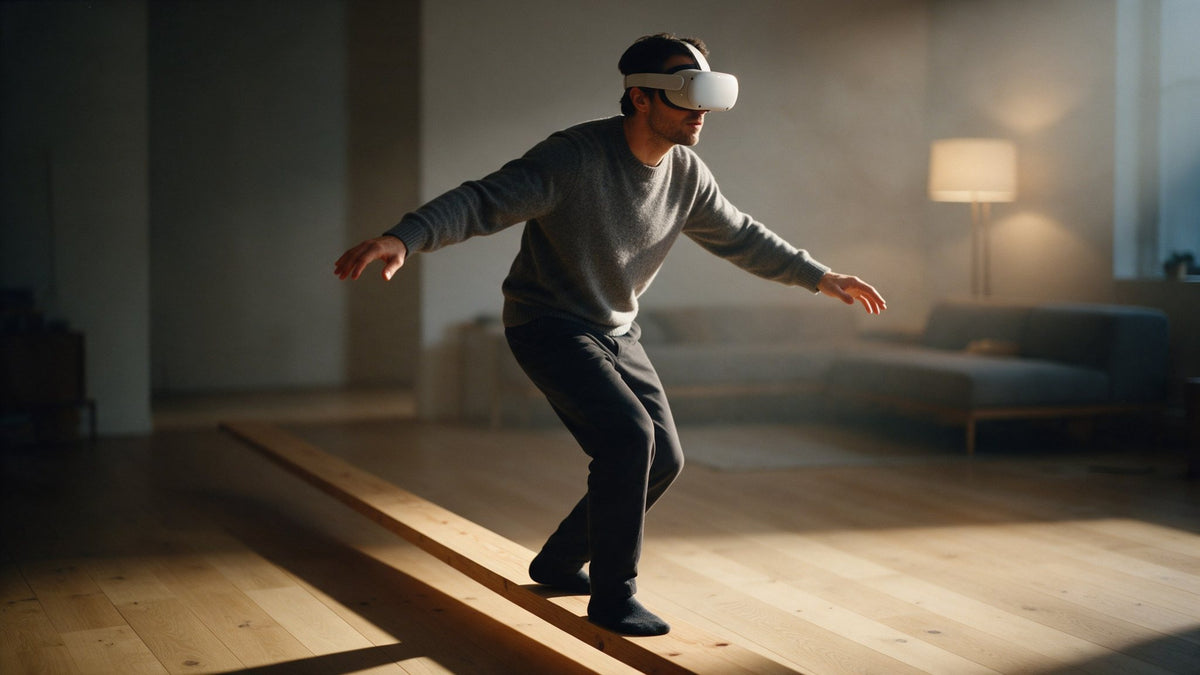
You put on the headset. An elevator opens onto a plank sticking out of a skyscraper, eighty floors up. Your brain knows you are standing in your living room. Your legs did not get the message. Your palms go damp, your knees lock, and that first step feels like a decision.
So why does VR feel so real, even when you know it is not? Researchers have been putting people on virtual ledges for more than twenty years to find out. The short answer: when a virtual world responds to your body the way the real one does, your body starts reacting as if it is there. Touch and sound make that effect stronger.
What researchers mean by "being there"
VR researchers call the feeling of being there presence. In a 2009 paper, Mel Slater split it into two parts (Slater, 2009). The first is place illusion, the sense of being in a real place. It depends on whether the world answers your movements: you turn your head, the view turns with you.
The second is plausibility illusion, the sense that what is happening is really happening. When both are present, Slater argues, people respond realistically, even though they know for sure they are not there. That is the plank in a sentence. You know. Your body responds anyway.
The virtual pit that made hearts race
One of the best-known experiments dates from 2002 (Meehan and colleagues, 2002). Across three experiments, volunteers moved between a non-threatening virtual room and a stressful virtual height. The researchers wanted an objective way to measure presence, so they tracked the body instead of only asking questions.
Change in heart rate worked best as a measure of presence. Skin conductance, a sign of sweating, worked to a lesser extent. Skin temperature did not work at all.
Two details stand out. First, smoother graphics mattered: presence was highest at 30 frames per second, lower at 20 and lower again at 15. Second, touch mattered. A real ledge on the floor, raised only a few centimeters, increased presence significantly. Feeling an edge under your toes made the drop more convincing.
Does a virtual drop work like a real one?
A 2012 study asked that question head on (Cleworth and colleagues, 2012). Seventeen people stood at low and high heights, both in a real setting and in a virtual copy matched in scale and detail.
In both worlds, height raised skin conductance and fear ratings and changed how people swayed. People also felt less stable and less confident in their balance. The real height still won on some measures: fear rose more with real height than with virtual height. But the virtual version moved the body in the same direction.
A real beam, a virtual 15 meters
Next came a real wooden beam, 3.8 centimeters wide and only 2.5 centimeters tall (Peterson and colleagues, 2018). Nineteen healthy young adults took part. Anyone who reported a fear of heights was left out. Each person crossed it three ways: with normal vision, in VR at ground level, and in VR 15 meters up. Step off the virtual high beam and you "fell" 15 meters.
At the virtual height, heart rate varied more from moment to moment: the beat-to-beat spread (the standard deviation) was 8.3 beats per minute, against 7.0 at virtual ground level. Average heart rate was the same in both VR conditions, about 97 beats per minute. The headset itself made balance harder: people stepped off far more often in VR than with normal vision.
A virtual steel girder jutting from a high-rise gave a similar result (Kisker and colleagues, 2019). People walked it more slowly at height than people who crossed the same girder at ground level. They also had a higher heart rate and reported a stronger sense of presence.

Why does VR feel so real? Touch and sound help
The ledge in the 2002 study points to something simple. The more of your senses a virtual world reaches, the more it feels like a place.
Another team tested it with a job to do (Cooper and colleagues, 2018). Seventeen people changed a wheel on a virtual racing car using a real tool. The researchers switched three kinds of cues on and off: sound, buzzes from motors on gloves (from 15 to 250 hertz), and visual signals. Sound cues and touch cues each made a clear difference. With all three, people finished fastest, in 46.9 seconds, against 55.2 seconds with no cues at all. They also rated their sense of presence highest.
Our own reading, which none of these studies tested directly: the plank works because it reaches more than your eyes. It reaches your balance, your skin and your ears together.
What science is still learning
These studies are small. Those with exact counts had 17 to 19 people, mostly young adults in a lab. Some used older headsets, such as an early development kit in the 2018 beam study. Presence is also measured in different ways, from heart rate to questionnaires, so results are not always easy to compare. Larger studies with newer headsets and a wider range of people would show how strong each effect is.
How to get more out of your next VR height moment
- Clear your play space. Height scenes make people step and lean. Give yourself room.
- Add something real underfoot. Many players lay a flat, stable board on the floor for plank games, the same idea as the 2002 ledge.
- Turn the sound on, at a comfortable level. Wind, creaking wood and distant traffic fill out the scene, and in one study sound cues raised presence ratings.
- Take breaks. Let your body settle between scenes.
So the next time your legs shake on a virtual ledge, you are not being silly. Your body is doing its job: believing what your senses report.

Where Woojer comes in
Vibroacoustics is sound you feel through contact. Haptics is the wider world of technology for the sense of touch. Woojer brings the two together. Our OSCI technology reproduces 1 to 250 Hz, the band the body reads as pressure rather than pitch, tightly synced to what you hear. In VR, that means the creak of the plank or a door slamming behind you reaches your body as well as your ears. Our Vest 4, including the version made for Meta, is built to bring that kind of low sound to your chest as you play. Our VR page and science page explain how it works.
Frequently asked questions
Why does VR feel so real? When a virtual world answers your movements and its events seem to happen to you, people respond as if they are there. Studies have measured that as changes in heart rate and skin conductance.
Why do my legs shake in VR height games? Height scenes change how people sway and balance, both in real and virtual settings. In one study, people felt less stable at virtual heights, much as they did at real ones.
Does sound make VR more immersive? In one small study of 17 people, audio and touch cues each had a clear effect on task times and presence ratings, and people did best with all cues on.
Does touch matter in VR? In two studies it did. A real ledge under a virtual one increased presence in a 2002 study, and buzzing glove cues improved performance in a 2018 study.
No study cited here tested Woojer products, and Woojer is a wellness device, not a medical device. This article is for general information only and is not medical advice.
Sources
- Slater M. Place illusion and plausibility can lead to realistic behaviour in immersive virtual environments. Philosophical Transactions of the Royal Society B, 2009.
- Meehan M, Insko B, Whitton M, Brooks FP. Physiological measures of presence in stressful virtual environments. ACM Transactions on Graphics, 2002.
- Cleworth TW, Horslen BC, Carpenter MG. Influence of real and virtual heights on standing balance. Gait and Posture, 2012.
- Peterson SM, Furuichi E, Ferris DP. Effects of virtual reality high heights exposure during beam-walking on physiological stress and cognitive loading. PLOS ONE, 2018.
- Kisker J, Gruber T, Schöne B. Behavioral realism and lifelike psychophysiological responses in virtual reality by the example of a height exposure. Psychological Research, 2019.
- Cooper N, Milella F, Pinto C, Cant I, White M, Meyer G. The effects of substitute multisensory feedback on task performance and the sense of presence in a virtual reality environment. PLOS ONE, 2018.
