

Why movie dialogue is so hard to hear, and what actually helps
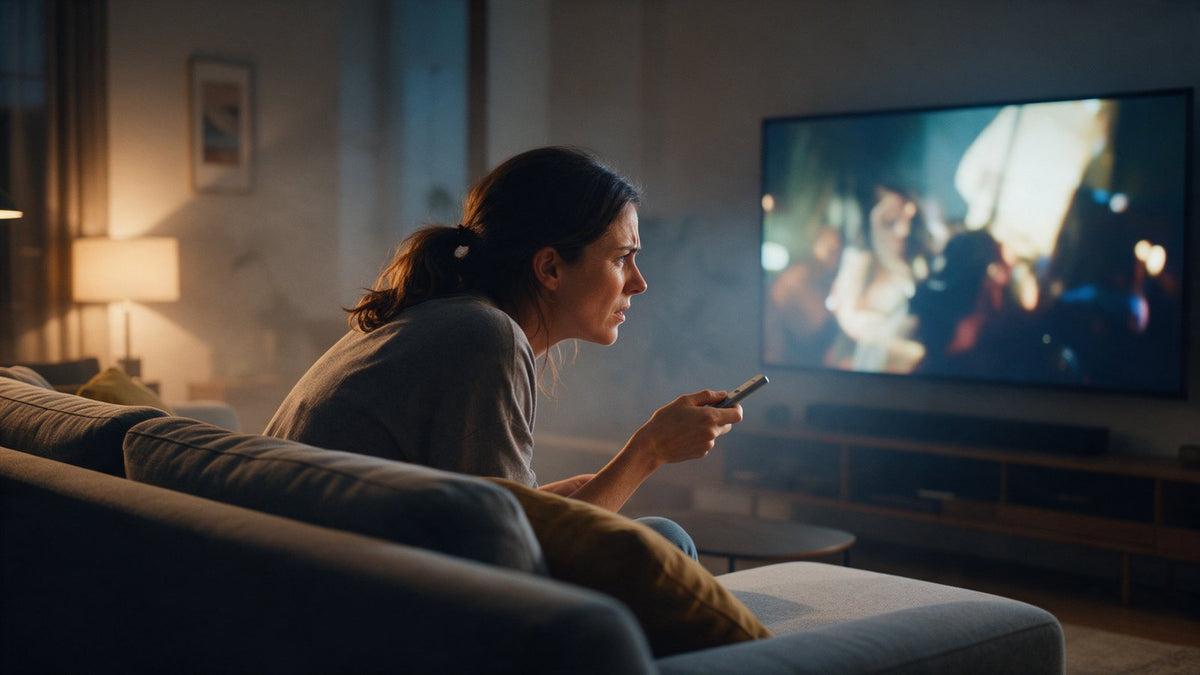
The characters whisper, so you turn the volume up. Then a car explodes, the windows rattle, and you lunge for the remote. Ten minutes later you are back to rewinding a line nobody caught.
So why is movie dialogue so hard to hear? Blame a chain of causes: how films are recorded, where they are mixed, how they are delivered, and what your living room does with them. For tonight, the short answer is to look for a dialogue or night mode in your TV settings. The causes come first, then six things worth trying.
In one survey, more than half use subtitles because of muddled sound
In 2025, NPR reported on a survey of 1,260 Americans by the language learning site Preply. More than half said they watch with subtitles on because the soundtracks are too hard to understand.
Younger viewers use them a lot, too. Production Expert, a trade site for audio professionals, cites a 2021 UK survey of 2,003 people in which 80 percent of 18 to 24 year olds used subtitles some or all of the time, against 37 percent of 46 to 55 year olds. People have many reasons for subtitles, from sleeping children to strong accents. Still, the complaint about sound keeps coming back.

Why movie dialogue gets lost: the mix is made in a much bigger room
One big cause is the distance between the studio and your sofa. A movie soundtrack is often balanced in a large, carefully tuned room at a high, calibrated level. Your sofa is not.
The same Production Expert piece points to the broadcast loudness guide ATSC A/85, which sets lower reference levels for smaller rooms: 85 decibels for rooms over 20,000 cubic feet, down to 76 decibels for rooms under about 1,500. In a big room, a whisper can sit far below an explosion and still be clear. At home, at a polite volume, that whisper may simply drop out of reach.
Some filmmakers want that gap. A quiet line makes the next bang feel bigger. As The A.V. Club reported, Andy Hay, who helped develop Netflix's standards, explained the difference: TV mixes anchor the dialogue first, while in features the story drives the decisions. That is lovely in a theater and harder to carry into a living room.
Sound professionals are divided on where home mixes should be made. In the Production Expert piece, Reid Caulfield argues they belong in smaller rooms at about 79 decibels, closer to how people really listen, not in a large theater set up at 85.
Streaming services mix and compress sound differently
Services now ask for mixes built for home. Netflix's Dolby Atmos home mix requirements describe a mix made for listening close to the speakers. The Production Expert piece puts Netflix's dialogue target at minus 27 LKFS, a standard unit of loudness, and its author considers that low. Sound professionals told The A.V. Club that specs differ from one service to the next, and that a mix can sound different at home than it did in the studio.
NPR's report adds a second issue. Services compress audio to reduce buffering, and sound editor Karen Baker Landers noted there is no industry-wide standard for it. So the same film can sound different on two platforms.
Softer acting and denser soundtracks hide words
Part of this is a creative choice. Modern microphones can catch a very soft performance. ScreenCrush editor Matt Singer told NPR there is a fine line between nuance and mumbling.
Soundtracks have also grown denser. Directors stack effects, ambience and music on top of each other. Christopher Nolan is the famous case. In a 2014 Hollywood Reporter interview quoted by NPR, he said, "I don't agree with the idea that you can only achieve clarity through dialogue."
Speech has to compete in that crowd. In a TV Technology article, Mary Gruszka notes that vowels sit mostly around 250 to 500 Hz, while hissy consonants, which help tell similar words apart, reach from 2,000 Hz up to about 8,000 Hz. Music and effects often fill the same space. Our guide to hertz explains the numbers.
Thin TVs squeeze the center voice into small speakers
Then the soundtrack reaches your television. Flat screens leave little room for speakers, and NPR's report points to small speakers that face the wall instead of you.
There is a layout issue too. In a surround mix, voices usually live in one center speaker, which is what keeps them anchored to the screen. A TV with two speakers has to fold that center channel into left and right, on top of everything else. Netflix's help page for voices that are too quiet even suggests switching to stereo on some devices.
A dialogue slider lets viewers pick the balance
One promising idea is to stop arguing about one perfect mix. Researchers at the University of Salford worked with BBC R&D on a trial with the medical drama Casualty. Dialogue, effects and music were kept as separate streams, and iPlayer viewers got a slider. One end gave the normal TV mix. The other lifted the dialogue and lowered some of the other sounds.
Similar help now exists on streaming services. Amazon says Prime Video's Dialogue Boost finds spots where speech is buried, isolates it and makes it clearer.

What actually helps at home
- Look for a dialogue setting. Apple TV 4K has Enhance Dialogue and Reduce Loud Sounds. Many TVs and soundbars have a speech or clear voice mode.
- Shrink the gap at night. A night or reduce loud sounds mode brings explosions down, so you can keep the volume steady.
- Try the stereo option. If a surround track sounds thin on TV speakers, the stereo format may carry voices better.
- Give voices a real speaker. A soundbar with a dedicated center channel gives speech its own speaker, aimed at you.
- Mind the room. Hard, bare rooms add echo that blurs words. Rugs and curtains can help, as they do when you record your own voice.
- Keep the subtitles on. Plenty of people use them, and with a muddy mix they are often the simplest answer.
The catch
Nobody has one clean measurement of this problem. The survey numbers come from a company poll and a trade article, and they mix several reasons for using subtitles. Much of what we know comes from sound professionals describing their own experience, and they do not fully agree on the main cause. Every film, service, TV and room is different, so a setting that rescues one movie may do little for the next.
Low rumbles are sturdy, voices are fragile
The low rumbles of a film are the sturdy part, long waves of the kind that pass through walls. The human voice is the fragile part. Next time you rewind a whisper, remember it was mixed for a much bigger room than yours, and reach for the dialogue setting before the volume. At Woojer, we build for that sturdy part: sound you do not just hear, so you really feel music, movies, games and live events.
Frequently asked questions
Why is the music so loud and the voices so quiet? Film mixes keep a wide gap between quiet and loud moments. In a small room at low volume, the quiet end gets lost first.
Is it my TV or the movie? Often both. The mix sets the gap, and thin TV speakers make voices harder to separate.
Why do so many people use subtitles? For many reasons: a muddy mix, thin TV speakers, strong accents, a sleeping house. One UK survey found heavy subtitle use among young adults too.
This article is for general information only and is not medical advice.
Sources
- NPR via KPBS. More than half of Americans use subtitles because audio is 'muddled,' survey finds, 2025.
- Production Expert. Why TV content sounds wrong in your living room in 2026.
- The A.V. Club. What? Huh? Why your favorite shows and films sound worse than ever.
- Netflix Partner Help Center. Netflix Dolby Atmos home mix deliverable requirements.
- Netflix Help Center. Voices are too quiet, but background sounds are OK.
- University of Salford. Salford improves audio on BBC Casualty.
- TechCrunch. Prime Video's new feature makes dialogue easier to hear, 2023.
- Apple Support. Change audio settings on Apple TV 4K.
- Gruszka MC. The importance of speech intelligibility. TV Technology, 2013.
