

Why bass goes through walls, and the words do not
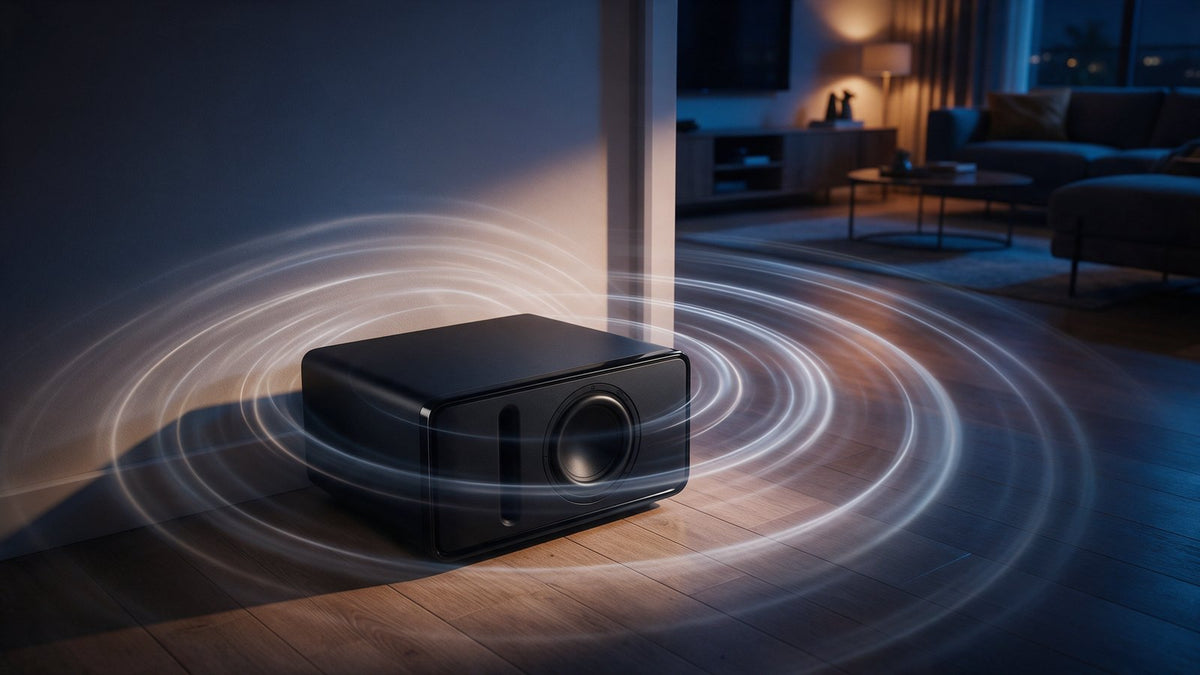
It is late, and through the wall comes a party next door. You cannot make out a single word of the song. You could not even say which song it is. But the bass comes through perfectly: a steady, dull thump you can almost feel in the floor.
Why does bass go through walls when the rest of the music stays behind? The short answer: low sounds make long waves that cycle slowly, and almost everything about a wall works better against short, quick ones.
Low sounds are long waves
Wavelength is speed divided by frequency, and sound moves through air at about 343 meters per second at room temperature.
A bass note at 50 Hz makes a wave nearly 7 meters long. A consonant like "s" sits high up, at several thousand hertz, with waves of roughly 4 to 10 centimeters. Our companion guide, hertz explained, goes through the numbers.
Long waves behave differently. They bend around obstacles and spread through openings that would block a short wave. HyperPhysics calls this diffraction: waves bend around obstacles that are small compared to their wavelength. A door gap, a window frame or a vent lets a 7 meter wave through and spreads it into the room beyond.
Walls stop high sounds more easily
A wall blocks sound mainly with its weight. When a sound wave hits it, the wall has to move a tiny amount to pass the sound on to the other side. Heavy walls resist that motion.
Acousticians describe this with the mass law, one of the oldest rules in the field. As New Zealand acoustician Keith Ballagh summarizes it in New Zealand Acoustics, a simple wall blocks about 6 decibels more for every doubling of its weight, and about 6 decibels more for every doubling of frequency.
That second part is the key. Take a bass note at 100 Hz and a voice sound at 400 Hz. The voice is two doublings higher, so the same wall blocks it by roughly 12 decibels more.
At 4,000 Hz, where much of the detail of speech lives, the voice sits more than five doublings above the bass: roughly 30 decibels more blocking on paper. Real walls fall short of the rule at some frequencies, but the pattern holds. The words are mostly stopped. The thump gets through.

The same physics at a traffic light
You have probably heard this outdoors too. A car pulls up at a red light with its windows closed, and all you hear is a thudding pulse. The car body works like a small, light wall. It holds back the vocals and the guitars, and lets the low end out.
You can test it at home. Play a song at a normal level, walk into the next room and close the door. Most of what reaches you will be the bass line and the kick drum. The words and the bright parts of the mix fade first.
Wall ratings mostly ignore bass
Walls and doors are often sold with a sound rating called STC, short for sound transmission class. It is a useful number, but it has a blind spot.
According to the Acoustical Society of America's standards glossary, STC is calculated from 16 frequency bands running from 125 Hz to 4,000 Hz. Nothing below the 125 Hz band goes into the number. Much of the energy in a bass line or a subwoofer sits lower than that. So two walls with similar ratings can perform very differently against bass, and the rating will not tell you.
Bass also reaches you as pressure, not just sound
There is one more reason bass is so noticeable through a wall. Low sound does not only reach the ears. In lab tests, the skin picks up the movement of surfaces it touches across a wide low range, as our hertz explainer describes, so the bottom of music can reach us through a floor or a seat as well as through the air. That may be why a neighbor's bass can feel more intrusive than its volume suggests.
That felt layer of sound is exactly what this blog is about. Our guide to vibroacoustic sessions explains how it is used on purpose.
The catch
These are rules of thumb for simple walls, and real buildings are more complicated. Sound also leaks through gaps, ducts and the building's structure, so the weakest path often matters more than the wall itself. A calculation can explain the pattern, but only a measurement can tell you how a particular wall performs.

What stops bass: weight, separation and sealed gaps
If the physics favors bass, what works against it? Three things, from most to least costly.
- Weight. Heavier walls, floors and doors resist low sound better, though each doubling of weight adds only about 6 decibels.
- Separation. Two layers with an air gap between them, not tied rigidly together, can beat a solid wall of the same weight. In timber-framed walls, Ballagh reports a gain of 5 to 10 decibels, a figure from a standard noise control handbook.
- Sealing. Because long waves slip through openings, closing gaps around doors, vents and frames helps. HyperPhysics notes that good soundproofing needs a well sealed room.
Weight and separation mean building work. Sealing is a quicker job. For most people, the fastest win is still at the source, not in the wall.
If you are the one making the bass
- Keep the subwoofer off shared walls and corners. Bass builds up in corners and passes more easily into the structure. A spot away from the neighbor's wall usually helps.
- Lift it off the floor. A dense pad under a subwoofer can reduce how much of it travels into the floor.
- Turn the bass down at night, not just the volume. The low end is what carries. Many systems let you lower it separately.
- Use headphones late. They keep the low end with you.
If you are the one hearing it
- Talk first. Many people simply do not know how far their bass travels, because in their own room the music sounds balanced.
- Mask the rest. A steady background sound can make the remaining thump less noticeable. Our guide to white, pink and brown noise explains how masking works.
- Be specific. Name the nights and the hours. A clear request is easier to grant than a general complaint.
Bass tends to win its argument with a wall. The practical answer is to turn the low end down at the source, and to knock on the door before the wall has to do the work.
Where Woojer comes in
That felt low end is what we build at Woojer: sound you do not just hear. Our OSCI technology reproduces 1 to 250 Hz, the band the body reads as pressure rather than pitch, and it reaches your body through contact. Here is how it works. No study cited here tested Woojer products, and Woojer is a wellness device, not a medical device.
Frequently asked questions
Why can I hear bass but not the words through a wall? Walls block high frequencies far better than low ones. The words live high, the thump lives low.
Does a thicker wall stop bass? A heavier wall helps, but slowly: doubling its weight adds only about 6 decibels of blocking.
Do foam panels stop bass from leaving a room? Very little. Thin foam adds almost no weight, and by the mass law weight is what stops low sound. Foam mainly changes how a room sounds inside.
Is a high STC rating enough for home cinema? Not on its own. STC leaves out everything below the 125 Hz band, where much of the bass sits.
This article is for general information only and is not medical advice. Talk to a qualified health professional about any health condition.
