

You feel the sound. Here is what your body is actually doing
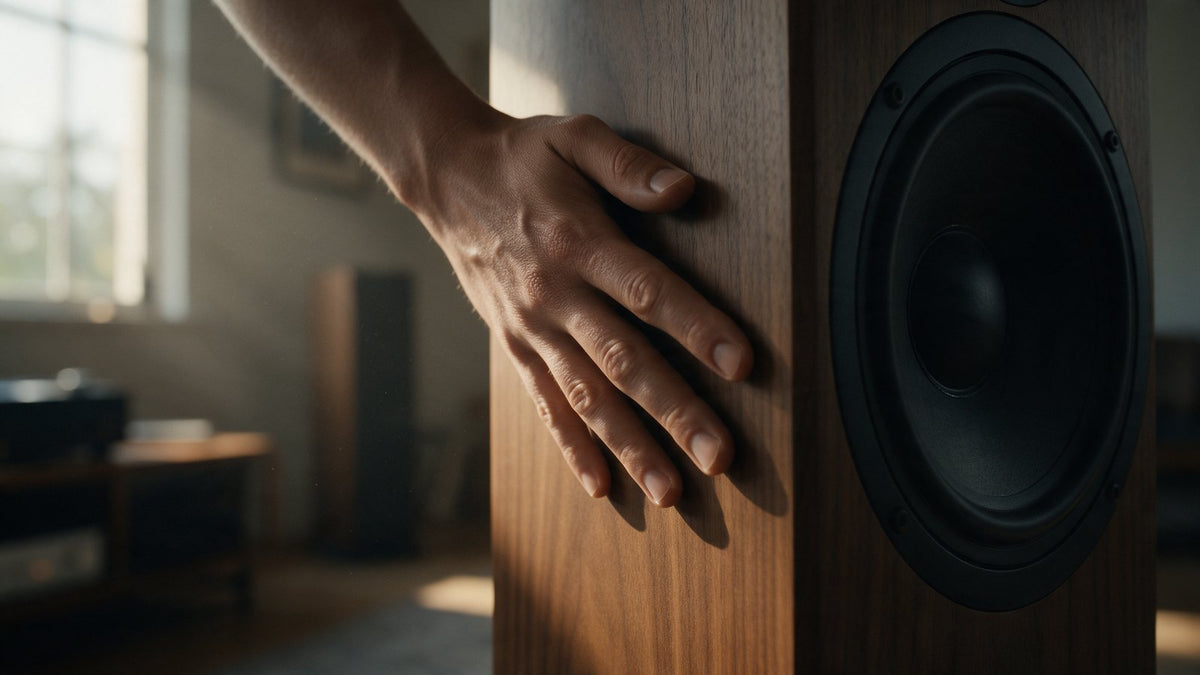
If you listen with Woojer, you already know the feeling. Sound reaches you before you think about it: a kick drum in your chest, a deep note humming through you while your ears are still catching up. Feeling sound is not the question. The interesting part is what your body is doing while it happens.
So how do we feel sound? Low sound often moves something you are touching, and tiny sensors in your skin report that movement. The story starts with four of them.
How we feel sound: the four sensors under your skin
Your skin holds several types of tiny pressure sensors, each tuned to a different job. A 2021 review in Nature Reviews Neuroscience by Annie Handler and David Ginty describes four structures in non-hairy skin, such as the palm.
- Merkel cells sit near the surface and report steady pressure and fine detail, like the edge of a coin.
- Meissner corpuscles respond to light, changing touch. The review says they are most sensitive to forces at about 40 to 60 Hz.
- Pacinian corpuscles sit deeper and specialize in fast movement. They respond best at about 100 to 300 Hz.
- Ruffini endings are thought to sense stretch, though the review notes that their role is still debated.
The numbers on the Pacinian corpuscle are striking. According to the review, the nerve fibers linked to it can respond to movement as small as 10 nanometers at 200 Hz. For scale, a human hair is thousands of times wider than that.
Together, these sensors let your hand feel a coin's edge, a phone buzzing in your palm, and the hum of a speaker cabinet under your fingers.
Skin and ears overlap at the low end
Classic lab work published in the Journal of the Acoustical Society of America in 1988 found four separate channels of touch working together at the threshold of feeling. Tested on non-hairy skin, they covered a range from about 0.4 Hz to beyond 500 Hz.
Hearing runs from about 20 Hz to 20,000 Hz, as our guide to hertz explains. So the two senses share a stretch of the low end, roughly 20 to 500 Hz going by those two figures. A bass note at 60 Hz sits inside both ranges. The top of a violin does not.
Felt sound travels through contact
Much of the sound you feel reaches you through contact. Low sound sets things moving, a floor, a seat, a speaker box, a Woojer worn against your body, and that movement passes straight into your skin.
That is why the lowest notes matter most. Their long, slow waves can set large, heavy things moving, and they travel through walls while the higher notes stay behind. A whisper never moves the floor. A subwoofer can. So when you feel the music, a fast chain is often at work: sound moves what you touch, that movement reaches your skin, and your sensors report it.
Where Woojer comes in
This is what we build at Woojer: sound you do not just hear. Our OSCI technology reproduces 1 to 250 Hz, the band the body reads as pressure rather than pitch. A precision transducer turns that signal into mechanical movement, tightly synced to the sound, and it reaches your body through contact. Here is how it works.

In small studies, touch also stirred the brain's hearing areas
Touch and hearing do not seem to stay in separate lanes in the brain. In a 2006 study in NeuroImage, Finnish researchers recorded brain activity from 11 adults with normal hearing while they touched a tube buzzing at 200 Hz. All of them reported perceiving a sound when they touched the tube, and nothing when they did not. In ten of the 11, the signal reached the touch area of the brain first, at about 60 milliseconds. Activity in the hearing areas followed at about 100 to 200 milliseconds.
A second study that year used fMRI brain scans on 13 people. A 200 Hz buzz on the fingers and palm activated part of the hearing cortex, and so did simple pressure pulses on the fingertips.
A 2009 study in Current Biology found another link. People were worse at judging a frequency by touch when they heard a distracting sound at a similar frequency. A distractor at a different frequency did not cause the same trouble, and judgments of intensity were not affected. So the two senses seem to be linked when it comes to frequency.
Touch alone can tell some instruments apart
In a 2012 series of experiments, Frank Russo and colleagues played tones through small drivers built into a chair, with noise masking any sound. People could tell cello, piano and trombone apart by feel at better than chance level.
A 2025 study in Scientific Reports tested 31 adults on six features of timbre, the quality that makes a cello sound unlike a piano. For two timing features, attack time and the depth of a pulsing change in loudness, adding touch to hearing gave better results than hearing alone. For attack time, the mix also beat touch alone. The touch signals were played to both hands through special gloves.

In one study, a moving seat raised listeners' ratings
In a study in the Journal of the Audio Engineering Society, Sebastian Merchel and Ercan Altinsoy sat 20 volunteers in a chair that could move with the low notes of concert recordings, from Bach on the organ to pop. Compared with no movement in the seat, listeners rated the experience about 27 points higher on average, on a scale from 0 (bad) to 100 (excellent), roughly one step on its five labels. The difference was statistically significant in this small group, and the paper found no clear difference between the tracks. Higher frequencies were not always welcome: some people reported a tingling feeling.
What science is still learning
Most of this research is young. The studies ran in labs, with small groups of healthy adults, and most of them tested hands and fingertips. The sessions were short lab tasks, and the brain scans show where activity rose, which is not the same as describing the experience itself.
What to notice next time you feel sound
- The place. Notice where in your body a song lands first: the chest, the back or the seat.
- The range. Low notes reach you through touch, high notes mostly do not. Listen for where the feeling fades as a song climbs.
- The rhythm. Close your eyes and follow the beat by touch alone.
Your ears and your skin are working the same song from two sides. Now you know what each of them is doing.
Frequently asked questions
How does the body feel sound? Low sound often moves something you touch, such as a floor, a seat or a Woojer you wear, and sensors in your skin report that movement.
What part of the skin feels low sound? Lab work points to Meissner and Pacinian corpuscles, which respond best to changing pressure at different speeds.
Why do I feel bass but not high notes? Low notes can set large objects moving, and they fall inside the range that lab tests have measured on the skin.
Is feeling sound the same as hearing it? No. They are different senses, but lab studies suggest they share some brain areas and interact.
No study cited in this article tested Woojer products. Woojer is a wellness device, not a medical device. This article is for general information only and is not medical advice. Talk to a qualified health professional about any health condition.
Sources
- Handler A, Ginty DD. The mechanosensory neurons of touch and their mechanisms of activation. Nature Reviews Neuroscience, 2021.
- Bolanowski SJ, Gescheider GA, Verrillo RT, Checkosky CM. Four channels mediate the mechanical aspects of touch. Journal of the Acoustical Society of America, 1988.
- Caetano G, Jousmäki V. Evidence of vibrotactile input to human auditory cortex. NeuroImage, 2006.
- Schürmann M, Caetano G, Hlushchuk Y, Jousmäki V, Hari R. Touch activates human auditory cortex. NeuroImage, 2006.
- Yau JM, Olenczak JB, Dammann JF, Bensmaia SJ. Temporal frequency channels are linked across audition and touch. Current Biology, 2009.
- Russo FA, Ammirante P, Fels DI. Vibrotactile discrimination of musical timbre. Journal of Experimental Psychology: Human Perception and Performance, 2012.
- Chauvette L, et al. Auditory and vibrotactile interactions in perception of timbre acoustic features. Scientific Reports, 2025.
- Merchel S, Altinsoy ME. The influence of vibrations on musical experience. Journal of the Audio Engineering Society, 2014.
- Woojer. The science of felt sound (woojer.com/pages/science).
