

Why a cat's purr feels so good on your lap, and how cats make it
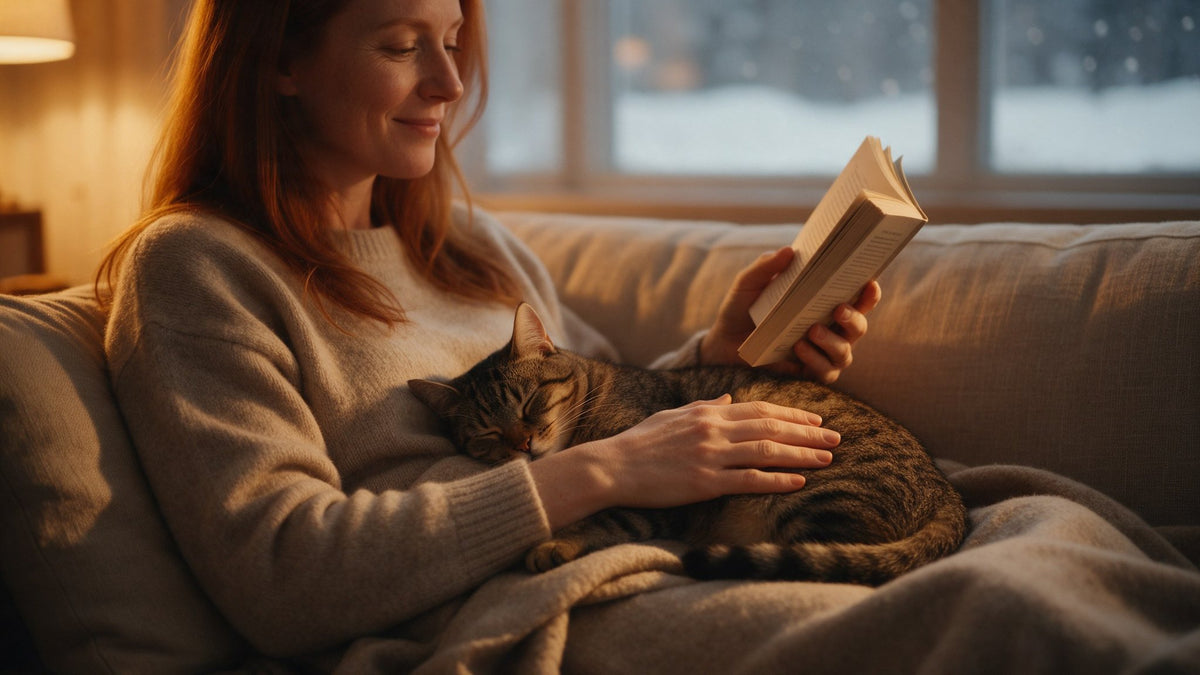
A cat climbs onto your lap, turns twice and settles. Then the motor starts. You can barely hear it across the room, but with your hand on its side you can feel it clearly, a steady rumble under your palm.
So why do cats purr, and why does it feel so good? The short answer: a purr is a very low sound, around 25 to 30 hertz, and you can feel it through contact as well as hear it. Scientists are still debating exactly how cats make it.
Why do cats purr? It starts with a very low sound
Pitch is measured in hertz, the number of times a sound wave repeats each second. Most of the sounds we hear every day sit far higher than a purr. A domestic cat's purr has a basic frequency of about 25 to 30 hertz, according to a 2023 study (Herbst and colleagues, 2023).
That puts the purr near the bottom of what we can hear. Our ears are much less sensitive down there, which is why a purr can seem quiet even when it is strong. (New to hertz? Our guide to what the numbers in sound actually mean explains.)

Why you feel a purr more than you hear it
Your skin senses movement too. A classic 1988 study mapped how we feel mechanical movement through the skin (Bolanowski and colleagues, 1988). It found four separate channels in hairless skin, such as the palm. Working together, they let us sense movement from at least 0.4 to more than 500 cycles per second, which is the same as hertz.
The purr's 25 to 30 hertz sits comfortably inside that range. So when a cat lies on your chest or under your hand, the rumble travels straight into your body through contact. Your ears can pick up some of it, and your skin can sense it too. For more on the senses involved, see our guide to how your body feels sound.
How a cat makes the sound
For decades, the main explanation was that a cat's nervous system drives the purr. In that view, bursts of nerve signals, typically 20 to 30 a second, make the muscles of the larynx, the voice box, twitch and chop the airflow, as the 2023 study below describes it. An early study of purring cats looked at this nerve and muscle side of purring (Remmers and Gautier, 1972).
The 2023 study challenged part of that story. A team led by Christian Herbst tested the voice boxes of eight domestic cats outside the body, with no nerves or muscles working. In the lab, air was blown through them. All eight still produced sound at typical purring frequencies, 25 to 30 hertz.
Under the microscope, the team found pads of connective tissue, up to 4 millimeters across, built into the cats' vocal folds. Those pads seem to let the folds move back and forth unusually slowly, the way a heavier string plays a lower note. The authors say their data do not fully rule out the muscle explanation. But they show the voice box itself can make the purr's low notes on its own.
Which animals really purr
Many animals make purr-like sounds, but a 2002 review argued that the word should be saved for sounds that share the same origin (Peters, 2002). By that standard, true purring is established only in the cat family and in a related family that includes genets and civets.
Similar sounds in other mammals, the review noted, most likely evolved separately. A purr, in other words, is a club with few members.

Why the moment feels so good
Part of the answer is the stroking. In 2009, researchers recorded nerve signals from people's skin while a soft brush moved across it at different speeds (Löken and colleagues, 2009). A group of slow-conducting nerve fibers, called C-tactile fibers, responded most at gentle speeds of 1 to 10 centimeters per second. Those were also the speeds people rated as most pleasant.
Time with animals may add to it. A 2019 trial split 249 university students into groups. Some spent 10 minutes petting cats and dogs. Others watched people pet the animals, looked at photos or waited. The students who petted animals had lower cortisol, a hormone linked to everyday stress (Pendry and Vandagriff, 2019). The authors describe it as momentary stress relief. None of this isolates the purr itself, but it helps explain the lap-cat moment.
What science is still learning
The purr mechanism is not settled. The 2023 study tested voice boxes outside the body, so it shows what the tissue can do, not everything a living cat does.
The petting trial measured one hormone over minutes, with cats and dogs together, so it cannot say what the purr itself added. We did not find studies that measured how a purr in contact with a person affects the person's body. Larger, purr-specific studies would help on each point.
How to enjoy a purr more
- Let the cat choose. Cuddles go best when the cat comes to you.
- Stroke slowly. In the touch study, people rated slow, gentle brush strokes on their own skin as the most pleasant. A slow hand may feel nicer to you as well.
- Rest a hand on its side. You will feel the rumble far more clearly than you hear it.
- Keep it quiet. In a calm room, the low hum is easier to notice.
Next time the motor starts, put your hand down and let your palm do the listening.
Where Woojer comes in
A purr on your lap is one of the most familiar examples of sound you feel. Vibroacoustics is the field of bringing that kind of low sound to the body through contact. Haptics is the wider world of technology for the sense of touch, and Woojer brings the two together. Our OSCI technology reproduces 1 to 250 Hz, the band the body reads as pressure rather than pitch, and the purr's range sits right inside it. On a Woojer MAT, low sound reaches your whole body through contact in quiet moments such as relaxation or meditation. Our science page shows how it works.
Frequently asked questions
Why do cats purr? Cats purr in many situations, such as resting on a lap. A 2023 study found that a cat's voice box can produce purring frequencies on its own, though scientists still debate the full mechanism.
What frequency is a cat's purr? A domestic cat's purr has a basic frequency of about 25 to 30 hertz, near the low edge of human hearing.
Why can I feel a purr more than hear it? Our ears are less sensitive to very low sounds, while the skin senses movement from at least 0.4 to more than 500 cycles per second. Contact brings the purr straight to your skin.
Which animals really purr? A 2002 review says true purring is established only in the cat family and a related family that includes genets and civets.
No study cited here tested Woojer products, and Woojer is a wellness device, not a medical device. This article is for general information only and is not medical advice.
Sources
- Herbst CT, Prigge T, Garcia M, Hampala V, Hofer R, Weissengruber GE, et al. Domestic cat larynges can produce purring frequencies without neural input. Current Biology, 2023.
- Remmers JE, Gautier H. Neural and mechanical mechanisms of feline purring. Respiration Physiology, 1972.
- Peters G. Purring and similar vocalizations in mammals. Mammal Review, 2002.
- Bolanowski SJ, Gescheider GA, Verrillo RT, Checkosky CM. Four channels mediate the mechanical aspects of touch. Journal of the Acoustical Society of America, 1988.
- Löken LS, Wessberg J, Morrison I, McGlone F, Olausson H. Coding of pleasant touch by unmyelinated afferents in humans. Nature Neuroscience, 2009.
- Pendry P, Vandagriff JL. Animal visitation program (AVP) reduces cortisol levels of university students: a randomized controlled trial. AERA Open, 2019.
