

Why some songs give you chills, and what your body is doing
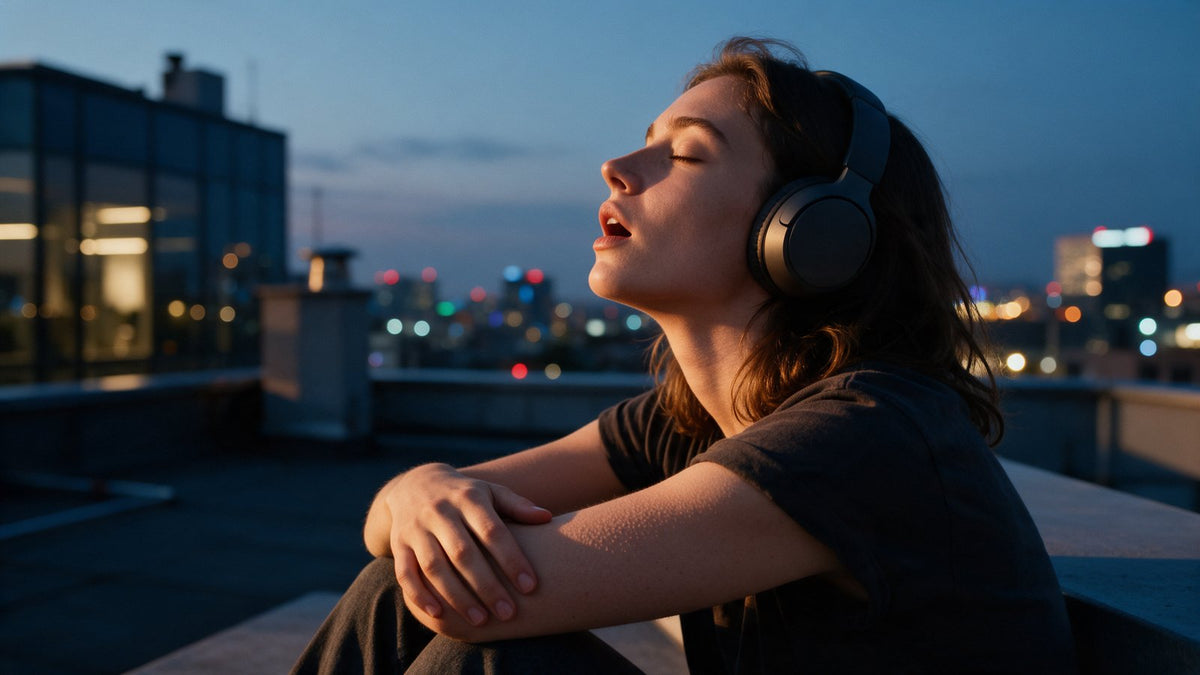
The song builds. The drums drop out, a voice comes in alone, and a shiver runs up your arms and across the back of your neck. You did not decide to feel it. It just arrived, right on cue.
So why does music give you chills? Scientists have been asking for decades, wiring listeners up to find out. The short answer: a chill is a reaction you feel in your body at a peak moment in music, and it lines up with activity in the brain's reward system. Here is what researchers have measured, and why some of us feel it more often than others.
What a music chill actually is
A music chill is a quick, tingling wave over the skin. It often comes with goosebumps, and researchers also call it frisson. A 2014 review by Luke Harrison and Psyche Loui notes that there is still no single agreed definition (Harrison and Loui, 2014). Some scholars count goosebumps as part of a chill. Others see them as a frequent companion.
Where it starts differs too. The same review cites work in which people most often felt chills in their arms, while fewer than half felt anything in their spine.

Your body reacts in ways researchers can measure
The best-known study came from McGill University in 2001 (Blood and Zatorre, 2001). Anne Blood and Robert Zatorre scanned 10 music students, each with at least eight years of training. Every volunteer brought one piece that reliably gave them chills. To keep the comparison fair, each person's piece also served as another person's neutral control.
The volunteers reported chills during 77 percent of the scans with their own music. During the most intense chills, their heart rate, muscle activity and breathing all rose.
A 2017 study from Japan compared two peak feelings (Mori and Iwanaga, 2017). University students listened to songs that gave them either chills or tears. Chills went with a rise in skin conductance, a sign of arousal, and the chill songs felt both happy and sad at once. Tears looked different: slower breathing while the heart sped up. Both were pleasurable.
The brain's reward system joins in
Back in the McGill scanner, something else happened. As the chills grew stronger, blood flow changed in brain regions tied to reward, emotion and arousal. The authors note that the same regions respond to other strong pleasures, such as food.
A 2011 study in Nature Neuroscience took the next step (Salimpoor and colleagues, 2011). Using a type of PET scan that tracks dopamine, a chemical messenger linked to reward, the team found dopamine release in a deep brain area called the striatum at the peak emotional moments of a song.
The timing is the interesting part. One part of the striatum was more involved while listeners were waiting for the moment they loved. Another was more involved when it arrived. In other words, the study suggests the build-up is part of the pleasure, not just the payoff.

The moments that tend to trigger a chill
Which parts of a song do it? The Harrison and Loui review points to sudden changes. The body's arousal system tends to spike at the start of sounds that are loud, very high, very low or quickly changing. Across the studies it reviews, heart rate, skin conductance and breathing depth have all been linked to the start of a chill.
In real music, that might be a swell after a quiet passage, a new voice entering, or a deep note landing under everything else. Deep notes are also something you can feel through contact as well as hear, as our guide to how your body feels sound explains. In the Mori study, songs people picked themselves gave more chills than songs the researchers chose.
Why some people get chills more often
Some people feel chills all the time. Others rarely do. A 2016 study led by Matthew Sachs looked for a reason (Sachs and colleagues, 2016). From an online survey of 237 people, the team picked 10 who often get chills and 10 who rarely or never do, matched for age, gender, personality and music training.
Brain scans showed a difference in the brain's connections. The frequent group had more volume in the white matter connecting hearing areas with regions involved in emotion and social processing. The authors call the follow-up correlations preliminary, since only 20 people were scanned, and a scan like this shows a link, not a cause.
What science is still learning
Most of these studies are small, with 20 people or fewer in the brain scan work, and often with music students or university students. Volunteers usually picked their own songs, which makes each listening session personal and harder to compare. A 2021 review in Psychological Bulletin found that the research had doubled since the previous review, and that researchers still debate the exact criteria for a chill (de Fleurian and Pearce, 2021). Larger studies with more varied listeners would show which of these findings are the strongest.
How to notice your own chills
- Start with songs you love. Several of these studies used songs people picked themselves.
- Stay with the build. If the waiting is part of the pleasure, skipping straight to the drop may skip part of the moment.
- Notice where it starts. Arms, neck, scalp or back: everyone's map is a little different.
- Listen for the change. A swell, a new voice or a deep note entering are places a chill can arrive.
If a song still gets you after the hundredth play, that is the build, the wait and the arrival doing their work.
Where Woojer comes in
The moments in this story, a build that lands or a deep note dropping in, live partly in the low end of a song, and that range is where Woojer works. Our OSCI technology reproduces 1 to 250 Hz, the band the body reads as pressure rather than pitch, and keeps it in step with the music, so those moments also reach you through contact. People wear a Woojer Strap 4 or Vest 4 for music, movies and games, and lie on the MAT for quiet listening. The science page explains how it works.
Frequently asked questions
Why does music give me chills? Chills tend to come at peak moments in a song, such as a sudden swell or a new voice. Studies link them to rises in heart rate, skin conductance and activity in the brain's reward system.
Are chills and goosebumps the same thing? Not quite. A chill is the tingling wave itself. Goosebumps often come with it, but researchers still debate whether they are part of the definition.
Is it normal not to get chills from music? Yes. People differ a lot. In one study, researchers picked out a group of volunteers who rarely or never get chills from music, from a survey of 237 people.
Why do I get chills from some songs and not others? In one study (Mori and Iwanaga, 2017), songs people picked themselves gave more chills than songs the researchers chose. Songs you pick yourself seem to work best.
No study cited here tested Woojer products, and Woojer is a wellness device, not a medical device. This article is for general information only and is not medical advice.
Sources
- Harrison L, Loui P. Thrills, chills, frissons, and skin orgasms: toward an integrative model of transcendent psychophysiological experiences in music. Frontiers in Psychology, 2014.
- Blood AJ, Zatorre RJ. Intensely pleasurable responses to music correlate with activity in brain regions implicated in reward and emotion. PNAS, 2001.
- Mori K, Iwanaga M. Two types of peak emotional responses to music: the psychophysiology of chills and tears. Scientific Reports, 2017.
- Salimpoor VN, Benovoy M, Larcher K, Dagher A, Zatorre RJ. Anatomically distinct dopamine release during anticipation and experience of peak emotion to music. Nature Neuroscience, 2011.
- Sachs ME, Ellis RJ, Schlaug G, Loui P. Brain connectivity reflects human aesthetic responses to music. Social Cognitive and Affective Neuroscience, 2016.
- de Fleurian R, Pearce MT. Chills in music: a systematic review. Psychological Bulletin, 2021.
