

Sound bath vs. vibroacoustic therapy: what is the difference?
Sound baths have gone from niche to mainstream. US search interest in the term rose by about 31 percent over the past year, according to Google Trends, and studios, spas and apps now offer them everywhere. Vibroacoustic therapy is far less familiar, but it is often mentioned in the same breath. Both use sound to help people slow down, but they work in different ways and their research is at different stages.
The short answer
How the sound reaches you. Sound bath: mostly through the air, to your ears. Vibroacoustic therapy: through contact, felt in the body.
Typical sources. Sound bath: singing bowls, gongs, chimes, voice. Vibroacoustic therapy: low-frequency tones, usually mixed with music, played through a bed, chair or mat.
Frequencies. Sound bath: broad and rich in overtones. Vibroacoustic therapy: focused on the low end, classically 30 to 120 Hz.
Setting. Sound bath: often a group class led by a practitioner. Vibroacoustic therapy: usually individual, in a clinic or at home.
Research base. Sound bath: a growing set of small studies (14 in a 2025 review), mostly without control groups. Vibroacoustic therapy: small randomized pilot trials and reviews, with a longer clinical history.
Cost. Sound bath: usually a class fee, or free recordings. Vibroacoustic therapy: clinic sessions, or a one-time consumer device.
What happens in a sound bath
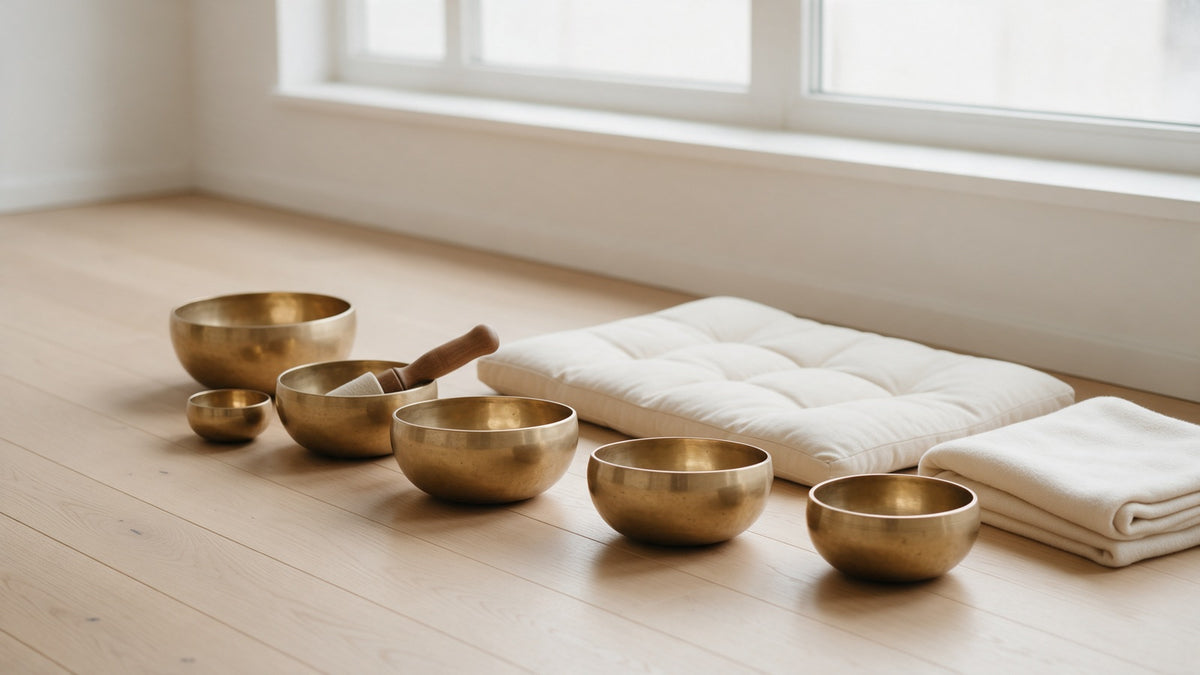
In a typical sound bath you lie down, close your eyes and listen while a practitioner plays instruments such as Tibetan singing bowls, gongs and chimes. The sound is mostly airborne. You may feel the deepest gong tones faintly through the floor, and some practitioners place a bowl directly on the body, but for most of the session the experience travels through your ears and your attention.
Part of the appeal is the character of the instruments themselves. A struck or rubbed bowl produces a main tone plus a halo of higher overtones that fade slowly, and when two bowls with close pitches ring together, their sound waves drift in and out of step, creating a slow, pulsing wobble. Gongs add a wash of complex, shifting sound. The result is less like a melody and more like a landscape you can let your attention wander through, which is why many practitioners present the sound bath as a form of meditation.

What happens in vibroacoustic therapy
In vibroacoustic therapy the sound is designed to be felt. Low-frequency tones, often blended with music, are played through a surface you rest on, so the vibration reaches skin, muscle and bone through contact. Many people describe the sensation as a gentle hum or pulse rather than a massage, and the music sets its pace. The approach was formally defined in Norway in 1982, and we cover its history and mechanisms in our guide to what vibroacoustic therapy is.
What the research says about sound baths
The best-known study is a 2017 observational study of 62 adults who took part in a Tibetan singing bowl meditation. Afterward, participants reported significantly less tension, anger, fatigue and low mood, and people new to the practice reported a larger drop in tension than experienced participants. There was no control group, so the study cannot separate the sound from simply lying down quietly.
Two systematic reviews have looked at the wider evidence. A 2020 review in Complementary Therapies in Medicine found only four peer-reviewed studies at the time and, given the small number and risk of bias, did not recommend singing bowl therapies yet. A more recent 2025 review in Healthcare gathered 14 quantitative studies and found improvements in self-reported mood measures and higher heart rate variability after sessions, while rating the certainty of the evidence as low to moderate, citing risk of bias and imprecision.
What the research says about vibroacoustic therapy
Vibroacoustic research is also early, but some of it is better controlled. In a 2022 pilot randomized trial, 54 students heard the same music on a vibroacoustic bed, and only one group received low-frequency vibration. That group showed a shift in heart rate variability toward rest-and-recover activity, while self-reported stress improved equally in both groups. A 2024 study in Sensors recorded a similar shift in heart activity and lower arousal in brain recordings during a 45-minute session, though without a separate control group.

The real difference: hearing versus feeling
The clearest distinction is the route. A sound bath is an auditory experience first: your brain follows the tones as they bloom and fade. Vibroacoustic therapy adds a tactile channel, the same kind of felt layer you notice when bass moves you (our sister blog looked at why bass makes you dance). Low-frequency energy delivered through contact reaches the body directly, and researchers studying sound vibration, such as the authors of a 2021 review of possible mechanisms, are investigating how that physical input interacts with blood flow, nerves and muscle. Those mechanisms are hypotheses still being tested.
What they have in common
Both ask you to stop, lie still and pay attention to something other than your thoughts. That matters. Music, quiet rest and expectation may account for part of how people feel; in the 2022 trial, the music-only group also reported feeling less stressed.
What neither one has shown
Neither sound baths nor vibroacoustic therapy has been shown to treat any medical condition. The evidence is also uneven: the sound bath studies are mostly observational, without control groups, while the vibroacoustic trials are small randomized pilots. Both use very different instruments, devices and session lengths. Feeling calmer after a session is real and worthwhile, but it is not the same as a proven clinical effect, and the research has not yet shown which approach, if either, is better for any particular goal.
What to expect the first time
At a sound bath. You will usually lie on a mat with a blanket and pillow, and the practitioner may open with a short breathing or body-scan exercise. Gongs in particular can get loud, so if you are sensitive to loud sound, choose a spot farther from the instruments or ask about volume before you start. It is normal for the mind to wander, and plenty of people drift off to sleep.
With vibroacoustic therapy. You lie or sit on the bed, chair or mat while music plays. As a general comfort tip, starting at a low intensity and turning it up gradually is the easiest way in, because the first few minutes can feel unfamiliar. Research sessions have typically run 20 to 45 minutes, as our guide to vibroacoustic therapy explains.
In both cases. Give yourself a few minutes to arrive rather than expecting instant calm straight off a busy commute. Let your breathing slow on its own, and stop if anything feels uncomfortable. If you have a medical condition, are pregnant or have an implanted electronic device, check with your doctor before trying vibration-based products.
Which one should you try?
It comes down to preference. If you enjoy group settings, live instruments and a guided experience, a sound bath is easy to find and to try once. If you are drawn to the physical sensation of sound, the deep hum you feel in your chest at a concert, contact vibration may appeal more. Consumer products now let you feel the low end of music at home, including the Woojer MAT. The studies above used other devices; none tested the Woojer MAT, and Woojer is a wellness device, not a medical device. Some people simply combine the two ideas, listening to calm music while feeling its low end. Whichever you try, give it a few minutes to land, and judge it by how you feel, not by what the brochure promises.
Frequently asked questions
Is a sound bath a form of vibroacoustic therapy? Not in the strict sense. A sound bath is mainly heard through the air. Vibroacoustic therapy delivers low frequencies through contact so they are felt, usually mixed with music.
Can you feel vibration in a sound bath? Sometimes. Large gongs and bowls placed on the body can produce noticeable vibration, but most of the experience is auditory.
Which is better for relaxation? There is no head-to-head research. Studies of both report people feeling more relaxed afterward, and small studies of each have recorded shifts in heart rate variability.
Can I do either at home? Yes. A recorded sound bath needs only headphones or speakers and a quiet room, though you will hear the lowest tones rather than feel them. Consumer vibroacoustic products let you feel low frequencies at home.
This article is for general information only and is not medical advice. Talk to a qualified health professional about any health condition.
Sources
- Goldsby TL, Goldsby ME, McWalters M, Mills PJ. Effects of singing bowl sound meditation on mood, tension, and well-being: an observational study. Journal of Evidence-Based Complementary & Alternative Medicine, 2017.
- Stanhope J, Weinstein P. The human health effects of singing bowls: a systematic review. Complementary Therapies in Medicine, 2020.
- Lin FW, Yang YH, Wang JY. Effects of Tibetan singing bowl intervention on psychological and physiological health in adults: a systematic review. Healthcare, 2025.
- Kantor J, et al. Effect of low frequency sound vibration on acute stress response in university students: pilot randomized controlled trial. Frontiers in Psychology, 2022.
- Fooks C, Niebuhr O. Effects of vibroacoustic stimulation on psychological, physiological, and cognitive stress. Sensors, 2024.
- Bartel L, Mosabbir A. Possible mechanisms for the effects of sound vibration on human health. Healthcare, 2021.
- Google Trends. "sound bath", "vibroacoustic therapy", United States, past 5 years (pulled 1 October 2026).